
Ancient Greek and Roman Studies

Ancient Greek & Roman Studies at Gettysburg College offers a holistic and interdisciplinary exploration of the ancient Greek and Roman civilizations, and connects the ancient world to modern life.
Students have the opportunity to study ancient Greek and Latin languages, literature, archaeology, history, art history, and philosophy, acquiring a rich knowledge of Greco-Roman antiquity and a deep foundation in humanistic inquiry. In our courses, students put the past in dialogue with the present, taking on topics and questions of contemporary significance that are crucial for leading meaningful lives in a complex world. We teach critical thinking as well as analytical and communications skills that prepare students to be engaged citizens and to succeed in a range of careers. We also encourage experiential learning through course performances of ancient works, study abroad in Greece or Italy, and participation in archaeological digs on campus and abroad with our faculty.
Majors & Minors
| Program Name | Program Type |
|---|---|
Ancient Greek and Roman Studies |
Major Bachelor of Arts |
Ancient Greek and Roman Studies |
Minor |
Greek |
Minor |
Latin |
Minor |
Why choose Ancient Greek and Roman Studies?
This is the place for you if you have a strong interest in the ancient Greeks or Romans and their modern legacy AND want to develop skills in thinking, reading, writing, and public speaking that are essential in today’s world and highly valued by employers. Our students came up with this list of 10 marketable skills they acquired through our major.
Ancient Greek & Roman Studies gives you the chance to engage with fascinating texts, objects, and ideas first on their own terms and in their original contexts, and then as important influences on modern culture and thought. Through studying, analyzing, and interpreting these ancient materials, you are challenged to think deeply about moral and ethical questions that are relevant today and develop practical skills and habits of mind that will serve you in any profession.
Why choose Ancient Greek and Roman Studies at Gettysburg
Opportunities
The relatively small size of our program means that faculty come to know each of our students personally and are responsive to their individual needs and interests. Through advising, mentoring, independent studies, and guidance in applying for study abroad, internships, jobs, and graduate school, we make sure that our majors and minors are nurtured at Gettysburg and beyond. We firmly believe that students of all backgrounds belong in Ancient Greek & Roman Studies, and we set up everyone for success. Our students also build close and meaningful relationships with one another in courses, during department social events, field trips, and invited lectures, and through extra-curriculars such as Classics Club and the Eta Sigma Phi Classical Honorary Society.

Academics
Our program is flexible, intimate, and inclusive. Rather than completing a fixed sequence of courses, our students choose from a range of offerings that approach Greco-Roman antiquity from different perspectives; this may include study of Latin or Greek, which affords students first-hand access to ancient cultures while also improving their facility in English and fulfilling the college’s second language requirement. Our major is compatible with pursuing a second major and/or minors in other departments, and we welcome the many students who do so, encouraging the integration of their areas of interest in course assignments and our senior capstone project.

Community of Experts and Professors
Our faculty members are not only award-winning teachers but also accomplished scholars with active research agendas. They bring their expertise in areas such as Roman archaeology and ancient Greek literature into the classroom. They also offer special opportunities for students, such as excavating a Celtic and Roman town in southern France or adapting and performing an ancient tragedy on campus.

Whether majoring or minoring, Ancient Greek and Roman Studies students benefit from small class sizes, close mentorship with faculty scholars, coursework that includes both research and creative assignments, and opportunities to engage with the ancient world through study abroad, archaeological fieldwork, and extracurricular student groups.
The curriculum cultivates not only understanding of ancient civilizations, but also the ability to think deeply and write clearly -- skills essential for careers in law, education, business, and beyond.
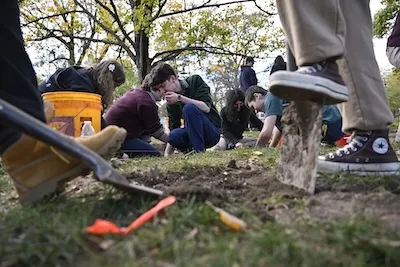
Archeology: Excavation Opportunities
2600 years ago, on the coast of Mediterranean France, was born the city of Lattara, now Lattes near Montpellier. Who founded Lattara? Was it native Celtic-speaking Gauls or Etruscans sailing over from Italy with ceramic containers of wine? In any case, Lattara was, from its origins, a place of meetings and exchanges.
Students should contact Prof. Benjamin Luley for information about the excavation at Lattes. Visit for more information.
Student Groups
Classics Club
The Classics Club offers social opportunities and classics-related activities for all students interested in ancient Greek and Roman history and culture. Club members generally gather several times a semester for meetings, arts and crafts projects, game or movie nights, and other events. They also organize lunches with Ancient Greek and Roman Studies professors and occasional field-trips to museums or theatrical productions.
Eta Sigma Phi, Honorary Society for Classical Studies (Alpha Pi Chapter)
Gettysburg College’s chapter of the national honorary society Eta Sigma Phi offers membership to students who have demonstrated excellence in the study of either ancient Greek or Latin. The mission of Eta Sigma Phi is to develop and promote undergraduate interest in classical study, to foster relationships among classics students, and to stimulate public interest more broadly in Greek and Roman cultures.
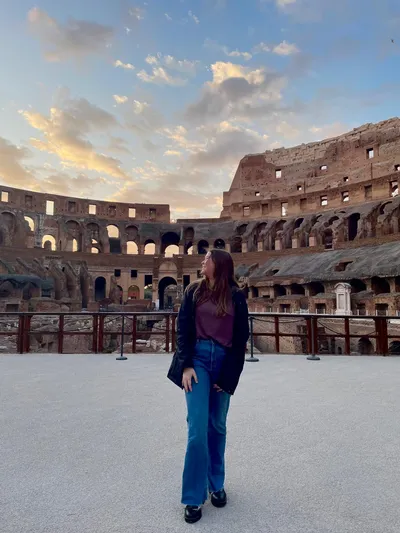
Study Abroad
Spend a semester in Athens or Rome! Read more about Global Studies programs for Ancient Greek and Roman Studies majors.
Experience the Tradition
Studying the Classics at Gettysburg College means joining a tradition of inquiry that’s as relevant now as it was two thousand years ago. You’ll explore the complexities of ancient civilizations, develop valuable interpretive skills, and learn to think critically about culture, language, and history. Whether decoding a line of Latin poetry or debating the ethics of imperialism in Roman texts, you’ll be doing great work—work that prepares you for a consequential life.
Featured Courses
Visit Curriculum tab for a comprehensive list of all available courses
100 Level
Exploration of great works of ancient Greek and Latin literature, including epic, lyric poetry, drama, philosophical dialogue, and literary criticism. Through analysis of these texts in discussion and writing, we consider what it means to be human, the shape of justice and morality, the power of rhetoric, social and political dynamics of gender, race, and class, and strategies of representation. Authors read may include Homer, Aeschylus, Sophocles, Euripides, Aristophanes, Plato, Aristotle, Virgil, Ovid, Cicero, Lucretius, Seneca, and others.
200 Level
Investigation of the impact that the Roman Empire had on the indigenous Celts and other peoples of Western Europe. The course takes a critical look at the idea that the spread of Roman "civilization" was ultimately beneficial to the supposed "barbarians" brought under imperial rule. The course also compares Roman colonialism with modern empires and imperial projects, and analyzes how examples of modern colonialism used the Roman Empire as a model and ideological justification for European colonial expansion and domination. ANTH 210 and CLA 210 are cross-listed.
In this course, we will study a selection of Ancient Greek tragedies by Aeschylus, Sophocles, and Euripides, and Roman tragedies by Seneca. We will consider the following questions: what defines tragedy as a genre, how and in what context were ancient tragedies performed, what do tragedies tell us about Greek and Roman values and beliefs, what were the social and political functions of tragedy in the ancient world, and what meanings and uses can re-performance of these tragedies have in diverse contexts in the modern world? Course activities may include performance and/or adaptation of ancient tragedy, and attending a live production of a tragedy.
Ancient Greek and Roman Studies News


At Gettysburg College, Ancient Greek and Roman Studies opens a window to the ancient world and equips students with the knowledge and skills to navigate today’s complex global society as well as the insight to lead meaningful lives.
The curriculum explores the languages, literature, history, philosophy, and material culture of ancient Greece and Rome. Whether you are delving into Homeric epics, studying ancient pottery, or analyzing Roman political and legal rhetoric, the program offers a rich and multidisciplinary foundation that fosters critical thinking, analytical precision, and cultural awareness.
Gettysburg College’s Ancient Greek and Roman Studies curriculum immerses students in ancient cultures through multiple avenues. For example, “Classical Mythology” introduces students to key Greek and Roman myths in ancient literature and art, while “Roman Civilization” provides an overview of Roman history, society, and politics. On a more advanced level, "The Ancient Mediterranean: Trade, Art, and Colonial Encounters" delves into the material culture of the ancient Mediterranean, examining artifacts to understand past societies and their interrelationships, while "Ancient Philosophy" offers an in-depth exploration of Greek and Roman philosophical traditions. The program’s focus on interpreting complex texts and objects and on understanding diverse cultural perspectives provides a strong foundation for careers in a variety of fields.
Major and Minor Information
The Ancient Greek & Roman Studies major at Gettysburg College allows students to explore ancient civilizations through interdisciplinary courses in literature, culture, archaeology, history, art history, and philosophy, alongside traditional Latin and Greek studies. Students can choose to study Latin or Greek, incorporating language-focused courses, or opt for cultural studies without language requirements.
Eleven courses are required for the Ancient Greek and Roman Studies major.
Nine Classics, Greek, and/or Latin Courses
- Can include two 100-level Classics courses or ANTH 106 and one 100-level Classics course
- Can include GRK 102, LAT 102
- Any Classics, Greek, or Latin courses at the 200 or 300-level
- At least one course must be at the 300-level
Extra-disciplinary Approach Course
- One course from the following: ANTH 221, 227, 300, ENG 210, 211, 212, 213, 214, 223, 299, 310, 312, 315, 316, 317, ES 230, HIST 208, 300, POL 102, REL 204, 205, THA 203, or other course approved by the Classics department.
Capstone
- CLA 400 Senior Seminar, approved CLA 464 Independent Research Capstone, or other 400-level Ancient Greek and Roman Studies course.
Six courses are required for the Ancient Greek and Roman Studies minor.
Six Courses from the Following
- Any Classics course beyond the 100-level.
- Any Greek or Latin course at any level.
- May include two courses from the following: CLA 103, 104, 122, 130, CLA/HIST 102, ANTH 106.
Notes:
- By special faculty action the Ancient Greek and Roman Studies Minor may include up to four 100-level courses.
- Students may select the Satisfactory/ Unsatisfactory grading option for courses applied to the minor. However, S/U grading for Greek and Latin courses may only be selected after completing the two-course sequence of language classes required by the Gettysburg curriculum.
Six courses are required for a minor in Greek.
Six Greek Courses
- Six courses in Greek at any level.
- One of the six courses may be a Classics course at any level.
Notes
- Only two 100-level courses may be counted toward the minor.
- Students may select the Satisfactory/ Unsatisfactory grading option for courses applied to the minor. However, S/U grading for the Greek courses may only be selected after completing the two-course sequence of language classes required by the Gettysburg curriculum.
Six courses are required for a minor in Latin.
Six Latin Courses
- Six courses in Latin at any level.
- One of the six courses may be a Classics course at any level.
Notes:
- Only two 100-level courses may be counted toward the minor.
- Students may select the Satisfactory/ Unsatisfactory grading option for courses applied to the minor. However, S/U grading for the Latin courses may only be selected after completing the two-course sequence of language classes required by the Gettysburg curriculum.
First Year Advising and Registration recommendations
Ancient Greek and Roman Studies is a multi-disciplinary department covering literature, archaeology, history, philosophy, art history, and ancient languages. Latin and Greek are not required for the major or minor, but all language courses at the 102 level and above count toward the Ancient Greek and Roman Studies major; both 101 and 102 count toward the minor.
Before you register
- Students wishing to begin studying Latin should register for LAT 101 in the spring semester; students wishing to begin ancient Greek should register for GRK 101 in the fall semester.
- Students wishing to continue Latin should take the Latin Placement test on Moodle; students wishing to continue ancient Greek should contact the department chair for placement.
- Students can also pursue a standalone minor in ancient Greek or Latin.
Common first-year courses
- One or two 100- or 200-level CLA, LAT, or GRK courses
- ANTH 106 Introduction to Archaeology (also counts for AGRS major and minor)
200-level CLA courses have no prerequisites and are open to all students. Some are cross-listed with Anthropology, History, or Women, Gender, and Sexuality Studies. Classical Studies courses meet the Humanities Requirement; some also meet Identities and Cultures or Race, Power, and Equity requirements.
Available Courses
100 Level
Survey of history, literature, art, architecture, etc. of Rome from its founding to the Council of Nicaea, with emphasis on the material culture of an empire encompassing the whole Mediterranean world. Normally offered every year.
Introduction to reading and pronunciation of Latin, with emphasis on vocabulary, morphology, syntax. Juniors and Seniors need permission of Department Chair.
Continuation of Greek I, introduction to ancient Greek in preparation for reading Attic and New Testament texts, with emphasis on vocabulary, pronunciation, morphology, and syntax. Offered every spring. Prerequisite: Greek 101 or placement.
Introduction to ancient Greek in preparation for reading Attic and New Testament texts, with emphasis on vocabulary, pronunciation, morphology, and syntax.
Continuation of Latin I, introduction to reading and pronunciation of Latin, with emphasis on vocabulary, morphology, syntax.
Exploration of great works of ancient Greek and Latin literature, including epic, lyric poetry, drama, philosophical dialogue, and literary criticism. Through analysis of these texts in discussion and writing, we consider what it means to be human, the shape of justice and morality, the power of rhetoric, social and political dynamics of gender, race, and class, and strategies of representation. Authors read may include Homer, Aeschylus, Sophocles, Euripides, Aristophanes, Plato, Aristotle, Virgil, Ovid, Cicero, Lucretius, Seneca, and others.
Survey of classical mythology, with attention to the process of myth-making, the development of religion and various critical approaches to mythology.
200 Level
What determines our sex and gender? What sorts of romantic and sexual relationships are acceptable, and why? Who and what define the binaries of male and female, gay and straight, and can individuals move fluidly between them? How do people’s gender and/or sexuality relate to their social and economic positions? This course investigates ancient Greece as a case-study for the way that gender and sexuality works, providing new perspective on our own world. WGS 240 and CLA 240 are cross-listed.
Survey of Hellenic civilization from the Bronze Age to the Hellenistic period. CLA 251 and HIST 251 are cross-listed. Offered every other year.
Survey of various sites and material cultures of the Mediterranean world, from c. 1500 BCE through 500 CE, including some discussion of the goals, methods, and cultural/ legal issues involved in archaeological research. Normally offered every other year. ANTH 255 and CLA 255 are cross-listed.
In this course, we will study a selection of Ancient Greek tragedies by Aeschylus, Sophocles, and Euripides, and Roman tragedies by Seneca. We will consider the following questions: what defines tragedy as a genre, how and in what context were ancient tragedies performed, what do tragedies tell us about Greek and Roman values and beliefs, what were the social and political functions of tragedy in the ancient world, and what meanings and uses can re-performance of these tragedies have in diverse contexts in the modern world? Course activities may include performance and/or adaptation of ancient tragedy, and attending a live production of a tragedy.
Designed to increase the student's skill in reading texts. Selections chosen at the discretion of the instructor. Offered every other fall. Prerequisite: Greek 102 or placement.
Introductory survey of the art and architecture of Ancient Greece and Rome, beginning with the Bronze Age in the Aegean to the reign of emperor Constantine. The course covers the history, culture and social context of major works produced by these civilizations and analyzes developments in style, taste and use of materials. Recommended ARTH 125. Offered once a year. ARTH 201 and CLA 201 are cross-listed.
Investigation of the impact that the Roman Empire had on the indigenous Celts and other peoples of Western Europe. The course takes a critical look at the idea that the spread of Roman "civilization" was ultimately beneficial to the supposed "barbarians" brought under imperial rule. The course also compares Roman colonialism with modern empires and imperial projects, and analyzes how examples of modern colonialism used the Roman Empire as a model and ideological justification for European colonial expansion and domination. ANTH 210 and CLA 210 are cross-listed.
Survey of the ancient peoples of Europe during the first millennium B.C. and their relation to the seven modern Celtic nations of the Atlantic fringe. Through an examination of archaeology, ancient history, mythology, and anthropology, this course investigates the relation between ancient and modern Celtic cultures, and the ways in which the archaeology of the ancient Celts has been used to construct modern Celtic identities. ANTH 214 and CLA 214 are cross-listed.
Study of philosophers and philosophies of ancient Greece and Rome. Emphasis is on the Pre-Socratics, Plato, Aristotle, Stoicism, and Skepticism. PHIL 205 and CLA 205 are cross-listed.
The purposes of this course are to develop students’ ability to read Latin verse, familiarizing them with various meters, genres, and authors of Latin poetry. In addition to developing students’ command of Latin grammar and vocabulary acquired in prior study, the course will focus on central questions involved in the interpretation of Latin poetry and the significance of particular poets and their works in the broader context of Roman literary history and culture. Poets and texts studied will vary from semester to semester. With departmental permission, students may repeat the course. Students who enroll in this course at the 304 level will have additional/special assignments as set by the instructor.
Pre-requisite for Latin 204: Latin 102 or by departmental permission or placement.
The purposes of this course are to develop students’ Latin reading skills and to familiarize them with the distinguishing features of various genres and authors of Latin prose. In addition to developing students’ command of Latin grammar and vocabulary acquired in prior study, the course will focus on central questions involved in the interpretation of Latin prose and the significance of particular authors and their works in the broader context of Roman literary history and culture. Authors and texts studied will vary from semester to semester. With departmental permission, students may repeat the course. Students who enroll in this course at the 303 level will have additional/special assignments as set by the instructor. Pre-requisite for Latin 203: Latin 102 or by departmental permission or placement.
300 Level
The purposes of this course are to develop students’ ability to read Latin verse, familiarizing them with various meters, genres, and authors of Latin poetry. In addition to developing students’ command of Latin grammar and vocabulary acquired in prior study, the course will focus on central questions involved in the interpretation of Latin poetry and the significance of particular poets and their works in the broader context of Roman literary history and culture. Poets and texts studied will vary from semester to semester. With departmental permission, students may repeat the course. Students who enroll in this course at the 304 level will have additional/special assignments as set by the instructor. Pre-requisite: At least one Latin course at the 200-level or above, or by departmental permission or placement.
The purposes of this course are to develop students’ Latin reading skills and to familiarize them with the distinguishing features of various genres and authors of Latin prose. In addition to developing students’ command of Latin grammar and vocabulary acquired in prior study, the course will focus on central questions involved in the interpretation of Latin prose and the significance of particular authors and their works in the broader context of Roman literary history and culture. Authors and texts studied will vary from semester to semester. With departmental permission, students may repeat the course. Students who enroll in this course at the 303 level will have additional/special assignments as set by the instructor. Pre-requisite: At least one Latin course at the 200 or above, or by departmental permission or placement
Study from both a theoretical and methodological level of the various forms of social inequality that emerged in the ancient world, as well as the forms of egalitarianism that have persisted throughout the world to the present day. The course emphasizes in particular a critical understanding of the ways in which ancient forms of inequality compare and contrast to what we see today in the modern world. ANTH 345 and CLA 345 are cross-listed.
What determines our sex and gender? What sorts of romantic and sexual relationships are acceptable, and why? Who and what define the binaries of male and female, gay and straight, and can individuals move fluidly between them? How do people’s gender and/or sexuality relate to their social and economic positions? This course investigates ancient Greece as a case-study for the way that gender and sexuality works, providing new perspective on our own world.
Survey of the ancient peoples of Europe during the first millennium B.C. and their relation to the seven modern Celtic nations of the Atlantic fringe. Through an examination of archaeology, ancient history, mythology, and anthropology, this course investigates the relation between ancient and modern Celtic cultures, and the ways in which the archaeology of the ancient Celts has been used to construct modern Celtic identities. Prerequisite: ANTH 103 or ANTH 106
400 Level
In-depth exploration of a unifying topic in Classics, using original Latin texts and appropriate historical, literary, philosophical or other analytical frameworks. Topics vary with the interest and expertise of the instructor. Prerequisite: 300-level course in Latin or permission of the instructor.
Individualized tutorial counting toward the minimum requirements in a major or minor, graded A-F
Individualized research for half credit (0.50 units), graded A-F
Individualized research counting toward the minimum requirements in a major or minor, graded A-F
Individualized tutorial counting toward the minimum requirements in a major or minor, graded A-F
Study of plans and monuments of Greek and Roman cities as well as writings of classical authors about cities and urban life. A combined archaeological, historical, and literary approach is used, with an emphasis on how the growth of cities depended on the development of technology for the construction of fortifications, large buildings, aqueducts, and other urban necessities. The course begins with the Mycenaean period in Greece and concludes with Roman cities of the 6th century AD. Prerequisite: One 100 or 200 level Classics course or permission of the instructor.
The Senior Seminar is offered periodically and meets the Capstone requirement for the major. Using appropriate analytical frameworks, students explore a topic selected by the instructor in a collaborative seminar format.
Ancient Greek & Roman Studies

More In Ancient Greek and Roman Studies
Ready to Do Great Work?
