
Women, Gender, and Sexuality Studies
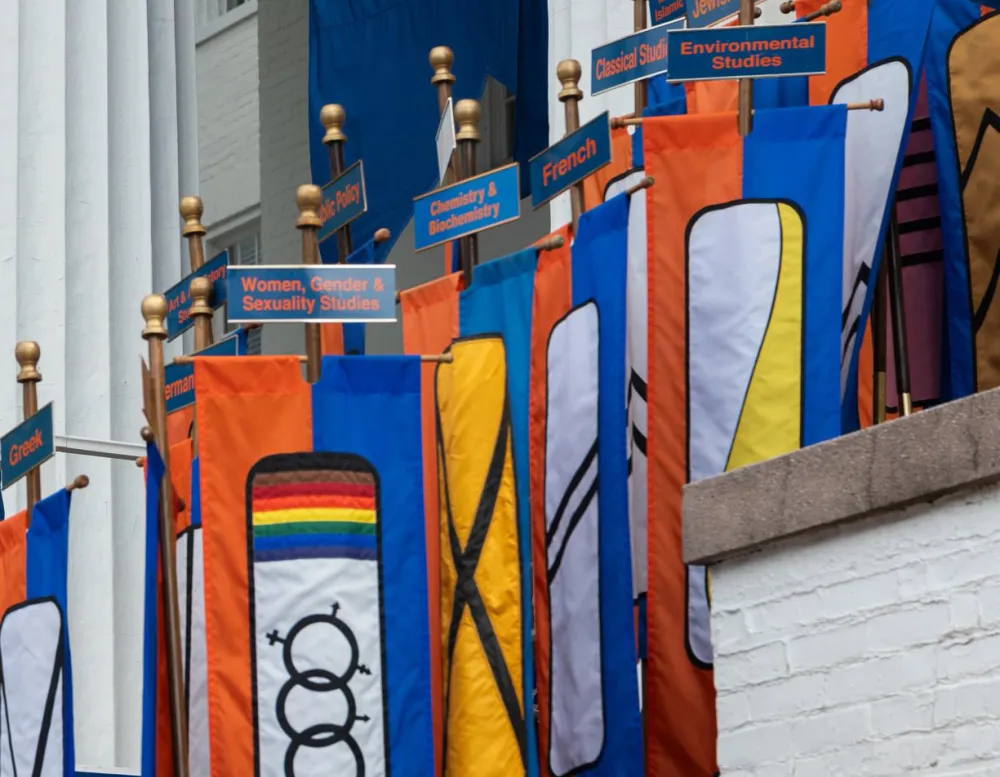
Students learn to think critically about diverse human experiences on local, national and global levels
Majors & Minors
| Program Name | Program Type |
|---|---|
Women, Gender, and Sexuality Studies |
Major Bachelor of Arts |
Women, Gender, and Sexuality Studies |
Minor |
Why study Women, Gender, and Sexuality Studies?
Learn to think critically about diverse human experiences on local, national and global levels. Examine cultural constructions of gender and sexuality, and their intersections with race, ethnicity, class, age and ability in relations to structures of power and inequality.
Opportunities
Understand modern feminisms in a global context by exploring topics in Women, Gender, and Sexuality Studies.

Academics
Whether you choose to major or minor in Women, Gender, and Sexuality Studies, you'll gain perspectives on people, places, and subjects in cultural and political contexts.

Community of Experts and Professors
Faculty members nurture student inquiry and support student learning outside the classroom through conference participation and scholarly research opportunities.

Our curriculum includes both interdisciplinary courses and courses grounded in disciplines such as history, literature, anthropology, psychology, sociology, economics and cinema/media studies.
In addition to developing theoretical analyses, students participate in hands-on learning experiences. Opportunities for student-driven research and informed activism are central to the WGS experience.
Major and Minor Information
Nine courses are required for the major.
WGS Core Courses
- WGS 120: Introduction to Women, Gender, and Sexuality Studies
- WGS 300: Theories OR and approved alternative
- SYS 208: Gender & Sexuality, Practicum in Advocacy & Social Change OR additional elective. WGS 320: Practicum counts for those who completed the Practicum prior to Fall 2026
- WGS 400: Senior Seminar
Five WGS Electives
- 5 courses from the categories of core, cross-listed, affiliated courses, or approved courses of Individualized Study.
- 1 of the 5 must be a core or cross-listed course above the 100-level that focuses in-depth on gender, sexuality, and/or the experiences of women, outside the United States, and Europe.
- 1 of the 5 must be a core or cross-listed course above the 100-level that focuses in-depth on the experiences of historically marginalized women, or on the ways that gender intersects with other forms of inequality, or on LGBT or Queer scholarship.
- No more that two of the elective courses may be from the category of affiliated courses.
Six courses are required for the minor.
Three Intro and Theories Courses
- WGS 120: Introduction to Women, Gender, and Sexuality Studies
- WGS 300: Theories OR approved alternative
- WGS 400: Senior Seminar
Three WGS Electives
- 1 core or cross-listed course above the 100-level that focuses in-depth on one of the following:
- On gender, sexuality, and/or the experiences of women, outside the United States, and Europe
- On the experiences of historically marginalized women
- On the ways that gender intersects with other forms of inequality
- On LGBT or Queer scholarship.
- 1 core or cross-listed course
- 1 course which can be core, cross-listed, affiliated or an approved course of Individualized Study
Notes
- Students may take one of the three elective courses in the Women, Gender, and Sexuality minor with the Satisfactory/ Unsatisfactory grading option.
First Year Advising and Registration recommendations
WGS is an interdisciplinary program exploring the experiences of historically marginalized groups through critical gender studies, focusing on women and LGBTQIA+ communities and the intersections of gender, sexuality, race, class, ethnicity, and more. WGS pairs well with many other majors and is a popular choice for double-majors.
Before you register
- Students considering a WGS major or minor are encouraged to meet with a WGS advisor to plan their coursework.
Common first-year courses
- WGS 120 Introduction to Women, Gender, & Sexuality Studies: recommended in first or second year
- Select First-Year Seminars also count as WGS electives
- 200-level WGS courses have no prerequisites and fulfill several Gettysburg curriculum requirements
A suggested sequence: WGS 120 in year one or two → SYS 208 or an elective in year two → WGS 300 (or approved alternative) in year three → WGS 400 Senior Seminar in year four.
Available Courses
100 Level
Philosophical study of love, relationships, marriage, sex, sexuality, sexual identity, and sexual representation. Philosophers have deeply explored knowledge, existence, politics and ethics. Yet love and sex, which for most of us are central features of a good life, have received far less attention. In this course material from philosophers who have thought about love and sex will be explored along with contemporary struggles around sexuality, sexual identity, sexual violence, love, romance, intimate relationships, and marriage. PHIL 125 and WGS 125 are cross-listed.
The course examines the changing practices in women's healthcare from the holistic, ancient, earth-based traditions that centralized women to the rise of the mechanomorphic American medical system, specifically gynecology. The course examines key historic events that shaped women's healthcare, issues of gender biology, women as medical research subjects, the gardener/mechanic metaphor, the modern medicalization of women's natural cycles, the Wise Woman healing tradition, Chinese medicine and acupuncture, Ayurveda, and issues around women’s personal empowerment. Social issues concerning the control of women's reproduction and the impact of the environment on women's health are addressed. Additional topics include holistic nutrition for females, body image, gender identity, sexual orientation, negotiating young-adult social and emotional challenges, and power and control in intimate relationships. Particular attention is on centralizing women, genderfluid, and trans people in their own healthcare and the impact of politics on their health by race and class.
Introduction to the conceptual tools for studying women and LGBTQIA individuals. Course introduces issues in feminist and sexuality studies theories, examines the diversity of experiences, structural positions in society, and collective efforts for change of women and LGBTQIA individuals.
200 Level
Comparative examination of inequalities within local sexual systems and situating them within a global context. Topics include social control and categorization of sexualities, and sexual identities and practices. The course investigates how religion and tradition shape these local systems. It also examines the hierarchies created by class and race within these systems. Last, the course discusses how these systems are being contested through activism. Throughout the course, discussions include how these systems simultaneously resist and accept the influences of globalization. Prerequisite: Sociology 101, 102 or 103 or permission of instructor. SOC 244 and WGS 244 are cross-listed.
A study of the work of four prominent Italian women directors: Liliana Cavani, Lina Wertmuller, Francesca Archibugi and Francesca Comencini. While focusing on their depictions of social, cultural and historical issues affecting modern and contemporary Italian society, the course also analyzes the relationship between gender and theories of visual and filmic representation. Topics include social realism, social satire, World War II, concept of family, violence, mechanisms of gender construction, gender and film. Taught in English. ITAL 280 and WGS 280 are cross-listed.
A survey of some of Italy's most prominent women writers of the twentieth century in English translation. The course covers a variety of themes dealing with the existential condition of women that surface in the writers' texts. Topics such as gendered writing, feminism, violence, gender (ex)change, feminine monstrosities and motherhood are the subject of students' analyses. Taught in English. ITAL 270 and WGS 270 are cross-listed.
Application of economic theory and empirical analysis to gender and LGBT issues, focusing on the US economy. Course explores how changes in family structures, gendered social norms, and macroeconomic conditions affect labor force participation, considers evidence regarding discrimination by identity and related differences in earnings, and evaluates how intersections of gender identity with race and ethnicity, sexual orientation, and social class impact individuals’ economic choices and the effects of public policies. Prerequisite: ECON 103, or ECON 105. ECON 252 and WGS 252 are cross-listed.
What determines our sex and gender? What sorts of romantic and sexual relationships are acceptable, and why? Who and what define the binaries of male and female, gay and straight, and can individuals move fluidly between them? How do people’s gender and/or sexuality relate to their social and economic positions? This course investigates ancient Greece as a case-study for the way that gender and sexuality works, providing new perspective on our own world. WGS 240 and CLA 240 are cross-listed.
An exploration of the diversity of women's familial, political, economic and social realities and experiences in West Africa and the African Diaspora in South America and the Caribbean. Particular attention is given to the processes by which indigenous West African gender and cultural patterns and their inherent power relations have shifted since pre-colonial times and across the Atlantic into the New World. Finally, the course examines the concept of Diaspora and theories relative to processes of cultural change, resistance, and retentions, as well as the role gender plays in these processes. No prerequisites. ANTH 231, WGS 231 and LAS 231 are cross-listed.
Study of women's activism to improve their lives around the world. Course analyzes similarities and differences in the issues women activists address in different parts of the world, the theories they develop to analyze those issues, and the forms their activism takes. Course also considers the possibilities for a global women's movement and provides theoretical tools for analyzing modern feminisms in their global context.
Study of women's activism and social movements organized primarily by women. Through the study of a broad range of women's activism, the course places the development of U.S feminism in its larger socio-historical context.
This course will explore the identity and the condition of women in Latin America and the United States. Latina and Latin American-women writers have illustrated women’s lives and experiences through their works and criticism. Their works have created women’s’ identities primarily from a borderline perspective, and sometimes from what Gloria Anzaldúa or Mary Louise Pratt refer to as a third space. For writers, the concept of space, gender, race, and class--as well as intersections and borderlands--play an important role when depicting Latin American women’s’ representation and Latina women in the United States and their experiences. We will use a comparative analysis utilizing texts from Latina and Latin American women writers to look feminist discourse across physical, geographic or abstract borders. The concept of space as an analytical tool will facilitate our textual analysis, and will serve to establish a common ground to discuss similarities and difference regarding women’s identity and their condition in Latin America and the United States. WGS 221 and LAS 222 are cross-listed.
Course explores various images of women as constructed for the male and female spectator in both dominant and independent film. Traditional ways in which women have been represented in film are examined critically through the use of feminist theories. Course aims to examine how various feminist filmmakers challenge the traditional uses of the female voice in their own films. Films from other cultures than the U.S. are included. WGS 220 and CIMS 225 are cross-listed.
This course investigates the controversial issues of pornographic discourse within a feminist context by examining the arguments that continue to divide feminists to this day. This course tracks the debate from a historical, theoretical and critical perspective. Particular focus is given to topics such as power structures and sexual oppression, the effects of pornography, the problems of a common definition, the implications of censorship, gender and representation, homosexual production and consumption of pornography, female subjectivity and agency, and the difference between pornography and erotica.
This course will analyze how our lives are shaped by gender. We examine how we are socialized to embody our gendered selves and how the world is organized to perpetuate gendered behaviors. We will pay particular attention to ways that social class, race, sexuality, and nationality intersect with gendered privileges. This course challenges us to envision ways to transform gendered structures and social behavior. We will explore ways to make lives more equitable and think deeply about everyday life and society with regard to gender. This course will count as an elective in the Public Health Policy major.
Prerequisite: Sociology 101, 102, or 103. SOC 217 and WGS 217 are cross-listed.
Study of traditional roles of primarily Eastern Woodlands indigenous women from pre-colonization to contemporary times. Indigenous women’s centrality in their nation’s sociopolitical structures, cosmology, and distribution of wealth is discussed. Additional emphasis is on ceremonial rites for women and girls, and traditional customs relating to sexuality, childbearing, and marriage. Ways in which indigenous women and men balance the responsibilities of their nation are a key topic.
Study of a topic not normally covered in depth in the regular curriculum of the Women, Gender, and Sexuality Studies program. Offered irregularly.
Emphasizes the forces that create migrations and the consequences for individuals who migrate, their societies of origin, and those that receive them. This course places a specific focus on the gendered aspects of global migrations, exploring the ways in which women, men, and LGBTQ peoples experience the various aspects of migration. The materials used in the course, such as books, articles, news media, films, guest speakers, represent the wide spectrum of aspects, both theoretical and experiental, of global migrations.
300 Level
This course will introduce students to the interdisciplinary field of queer studies. We begin with the history of LGBT identity in the West. We then explore the gay and lesbian liberation movement, distinguishing between assimilationist and liberationist approaches to LGBT social movements. We then discuss the difference between LGBT and queer identities, focusing on the rise of queer theory and queer politics. Throughout the semester, we will consider the relationship between queer studies and studies of transgender identity, race, ethnicity, disability, class, nation, and globalization. We will end with a critique of the notion of a global gay identity from the fields of queer globalization studies and queer of color studies. Prerequisite: WGS 120, or permission of instructor.
Introduction to the various research methodologies represented in the interdisciplinary field of Women, Gender, and Sexuality Studies. Course studies feminist and LGBTQIA critiques of traditional disciplinary methods. Goal is to familiarize students with the strengths and weaknesses of the techniques of inquiry in their disciplinary perspective of choice through explicit examples and a series of lectures. Emphasis is on preparation for senior research project to be completed during the Senior Seminar. Prerequisite: WGS 120 and one other core or cross-listed WGS course, or permission of instructor. Recommended: WGS 300 or 310.
Examination of the relationship between theory and collective action to improve societal conditions for women and LGBTQIA individuals. Course considers both theories of collective action and how theories inform collective action. Format combines seminar meetings with student internships in community organizations. Readings about collective action and about the relationship between theory and action provide a basis for analyzing students’ internship experiences. Prerequisites: WGS 120 and one other core or cross-listed WGS course, or permission of instructor.
Theoretical approaches to the experiences, representations, and relative positions of women and LGBTQIA individuals in diverse societies. Contemporary and earlier works are discussed in order to evaluate and synthesize multiple approaches. Prerequisite: WGS 120, or permission of instructor.
400 Level
Examination of a topic from a variety of in-depth perspectives. Selected topic is broad enough to allow students to engage in projects of their own devising. Course serves as a bridge between the undergraduate experience and the world beyond Gettysburg College as students learn to put their feminism into actions. Prerequisites: WGS 120, WGS 300 or 310, 340 and one additional core or cross-listed WGS course.
Individualized tutorial counting toward the minimum requirements in a major or minor, graded A-F
Individualized research counting toward the minimum requirements in a major or minor, graded A-F
Individualized research not counting in the minimum requirements in a major or minor, graded A-F
Internship counting toward the minimum requirements in a major or minor, graded A-F
Internship not counting in the minimum requirements in a major or minor, graded S/U
Women, Gender, and Sexuality
More In Women, Gender, and Sexuality Studies
Ready to Do Great Work?
