
Anthropology
Explore what it means to be human.
At Gettysburg College, anthropology invites you to understand the complexities of culture, society, and human behavior across time and around the world. Through immersive, discussion-based classes and hands-on research, you’ll build the skills to observe, analyze, and engage with our shared human experience. Whether you're uncovering ancient civilizations or examining modern communities, anthropology will help you see the world—and yourself—in a whole new way.
Majors & Minors
| Program Name | Program Type |
|---|---|
Anthropology |
Major Bachelor of Arts |
Anthropology |
Minor |
Why study Anthropology?
Anthropology gives you a deep, nuanced understanding of human life—past and present. It teaches you to think critically about cultural practices, social structures, and the forces that drive human behavior. You'll also gain valuable skills in research, writing, and cross-cultural communication.
From museums and libraries to global development organizations and government agencies, anthropology graduates play key roles in helping institutions and communities better understand human experience. An anthropology degree can open doors to careers in education, marketing, archaeology, forensics, public health, museum curation, social work, and beyond. Many students also pursue graduate studies in anthropology, sociology, law, and international relations.
Why study Anthropology at Gettysburg
Opportunities
Anthropology at Gettysburg College offers more than an academic foundation—it provides a transformative experience. Our program encourages you to shape your own path through a flexible curriculum that supports both cultural anthropology and archaeological anthropology concentrations.
Discover the endless possibilities that await when you study humanity—past and present.

Academics
The Anthropology curriculum is filled with thought-provoking, eye-opening courses that challenge you to think critically and globally. As an anthropology major, you’ll engage with the field through both academic inquiry and experiential learning. The major and minor are designed to let you explore human history and culture from multiple angles while developing strong research and analytical abilities. Whether your interest lies in ancient civilizations or contemporary communities, you’ll gain the tools to critically examine societies and cultures through an interdisciplinary lens. Anthropology students graduate with a deep understanding of global perspectives and the real-world skills to communicate across cultures and disciplines.

Community of Experts and Professors
Whether you're analyzing ancient ruins or exploring modern-day communities, Gettysburg’s anthropology program equips you with the knowledge, research opportunities, and real-world experiences to thrive. Here, you'll benefit from close faculty mentorship, immersive fieldwork, and unique global opportunities.

Conduct an archaeological excavation in Brazil, volunteer at a local museum, or develop your honors thesis while studying abroad. Eligible students can join Lambda Alpha, the National Honor Society for Anthropology, and build lasting professional connections through our alumni network.
The possibilities are endless!

As an Anthropology graduate, you might focus on a particular world area, such as Latin America, Asia-Pacific, Africa, Europe, North America, or the Middle East. Attend archaeological field schools or volunteer with projects. Past students have worked in the United States, Italy, Honduras, England, Macedonia, South Africa, and more.

With a liberal arts education at Gettysburg and a major in anthropology, students are prepared for virtually any career path. Employers embrace the cross-cultural experiences and sensitivity that anthropology majors possess. They also consider students’ solid grounding in anthropological research methods to be a plus. Our students have found work in the government and in the non-profit sector. In addition, many anthropology majors spend several years volunteering with Teach for America or the Peace Corps. Others attend graduate school to pursue further academic study in such fields as American Studies, Classics, History and, of course, Anthropology.
I’ve always had varying interests and loved learning people’s stories.”
– Amy Evrard, Associate Professor of Anthropology
Hopkins House Archaeological Project
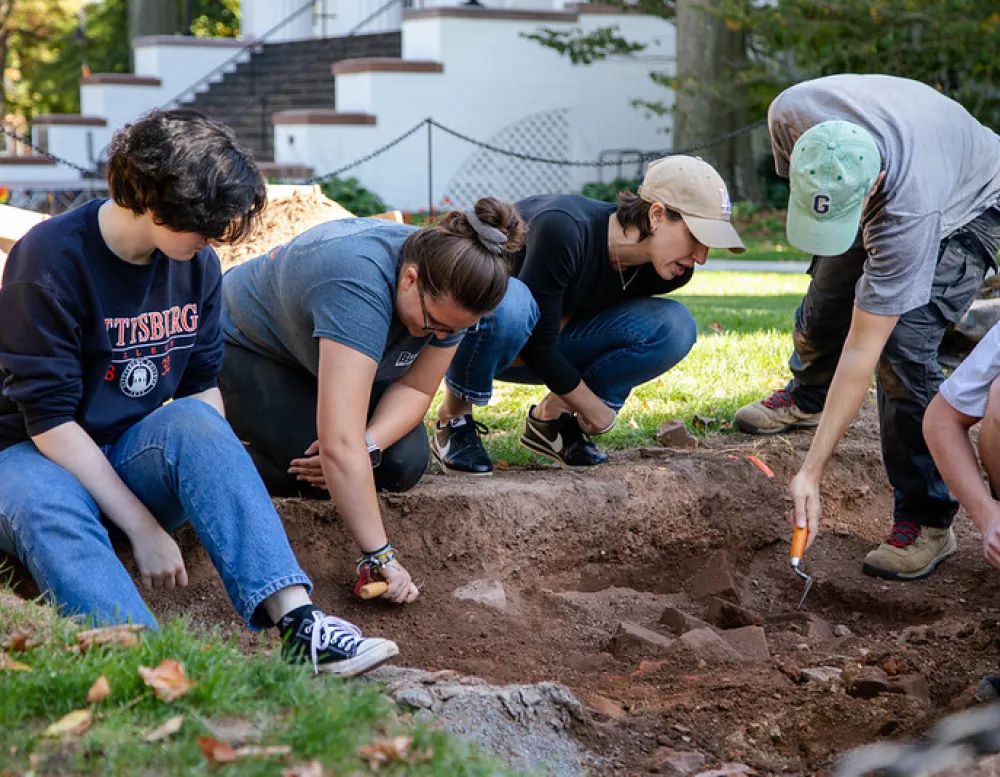
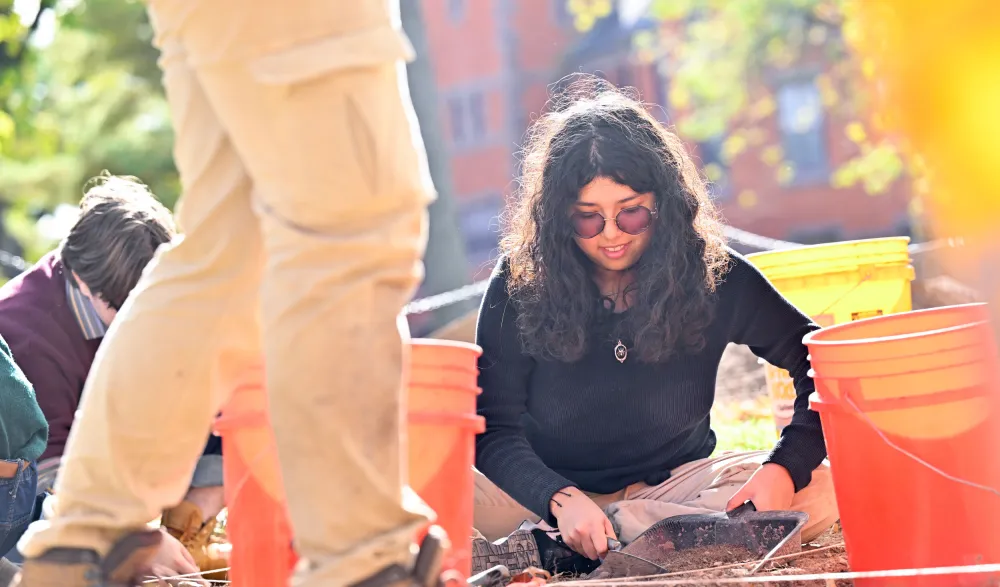
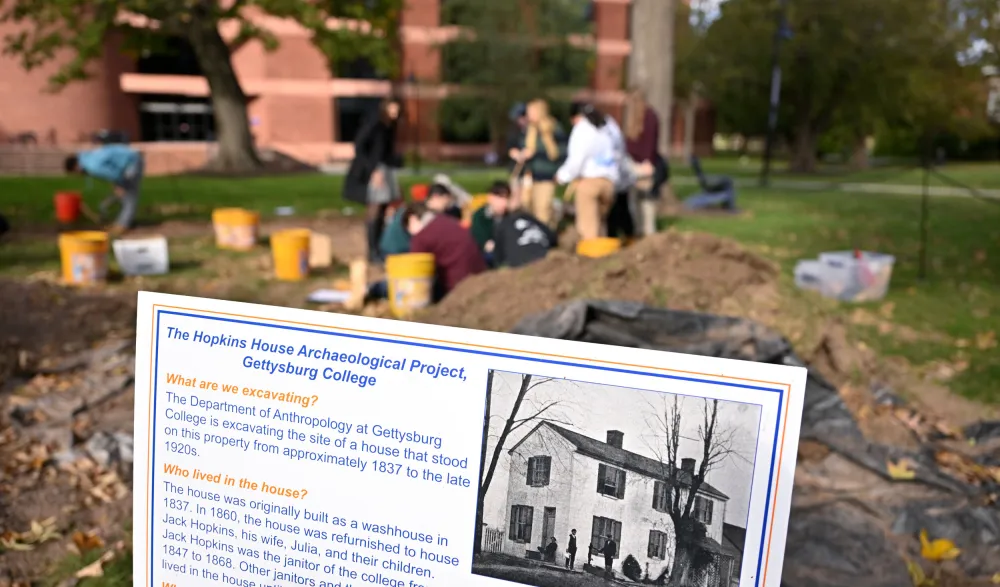
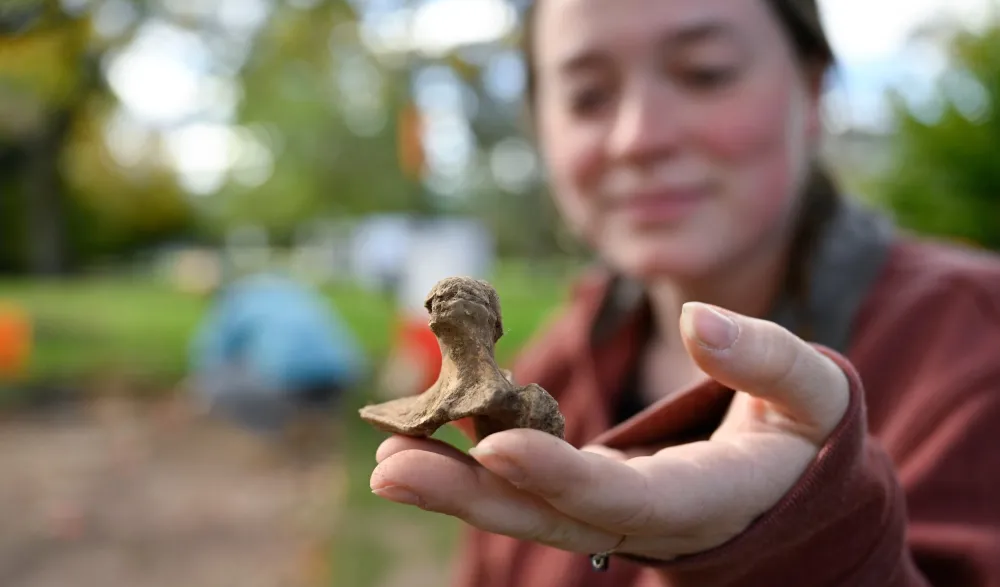
The Hopkins House Archaeological Project is a multi-year archaeological project that is being conducted on campus. The Hopkins House was located near the northwest corner of Penn Hall and was the residence of Jack Hopkins an African American man and the college’s janitor between 1848-1868.
This research is directed by professors Kirby Farah and Ben Luley and conducted by students in their classes—ANTH 324: Archaeological Field Methods and ANTH 212: Archaeology of Pennsylvania.
Lambda Alpha
The National Anthropology Honors Society Theta of Pennsylvania - Gettysburg College
Lambda Alpha is the national honor society for Anthropology. Its purpose is to encourage and stimulate scholarship and research in Anthropology by recognizing and honoring superior achievement in the discipline among students engaged in the study of Anthropology.
Eligibility
- student must be an anthropology major or minor
- he or she must have completed at least four courses in anthropology (none S/U)
- he or she must be a junior or senior
- he or she must have a minimum GPA of 3.6 in anthropology classes
- the student must have a minimum GPA of 3.5 overall
Every spring (usually in late March/early April) the department hosts an induction ceremony and dinner. The department also presents members with honor cords to wear at graduation. Lambda Alpha members are automatically eligible to complete an honors thesis in their senior year and encouraged to do so. For more information on an honors thesis, please see your advisor or consult the instructional documents filed on the Angel site.
To find out more, contact Donna Perry, faculty sponsor: dperry@gettysburg.edu
Featured Courses
Visit Curriculum tab for a comprehensive list of all available courses
200 Level
Survey of the major archaeological sites and time periods of Pennsylvania from the earliest peoples to the twentieth century. The class focuses in particular on archaeological practice, including participation in excavations and working with artifacts. Other important themes include the use of both archaeology and historical texts to understand the past, and the ethics of archaeological practice and interpretation, especially in regard to the material record of the state's original peoples.
Study of food as a lens for understanding culture and globalization. The course considers religion, gender, ethnic identity, socioeconomic inequality, exchange, and nationalism through the study of the production and consumption of food in local and global settings. The course examines debates on the impact of globalization on local cultures through case studies of colonial food trades and contemporary global food industries.
300 Level
A study of human rights examined cross-culturally. The course focuses on gendered violence, violation of children's rights, genocide and ethnic persecution, refugees and exile, and disease and healthcare. Students explore linkages between non-Western peoples and transnational advocacy networks; media representation of indigenous peoples and human rights victims; processes of truth and reconciliation; and the fragility of domestic and national bonds in the face of human rights abuses. Students view these topics primarily through the lens of cultural anthropology, but include works by medical and forensic anthropologists. Prerequisites: Anthropology 103 or 106
Anthropology Experience News

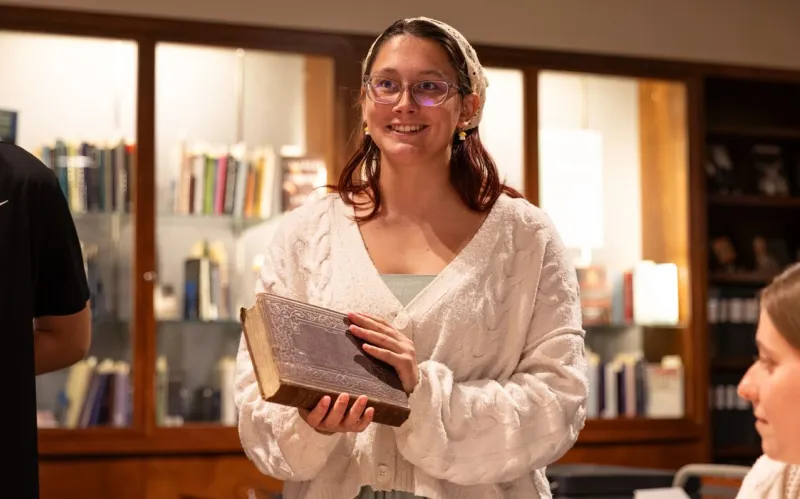


Indulge your curiosity about the world and how people make their way in it as an Anthropology major or minor.
You’ll learn about human cultures throughout history, explore the richness and diversity of human life in the present as well as the past, and investigate human practices, relationships, and value systems—both their commonalities and what sets them apart. Your studies can focus on two of the four major branches of anthropology - cultural and archaeological - and you’ll have flexibility to set your own direction.
Our Anthropology curriculum is designed to help you develop strong critical thinking and communication skills. Through discussion-based, lively, and interactive classes, you’ll learn to think like a global citizen, gaining enhanced cultural awareness and sensitivity, as well as insight into some of the world’s most pressing social problems.
Major and Minor Information
Ten courses are required for the ANTH major.
Five Core Courses
- ANTH 103 Intro to Cultural Anthropology
- Must earn a grade of C- or better
- ANTH 106 Intro to Archaeology and Physical Anthropology
- Must earn a grade of C- or better
- ANTH 300 History of Anthropological Theory
- Methods course from ANTH 323 or ANTH 324
- ANTH 400 Capstone Experience in Anthropology
Five Anthropology Electives at the 200 or 300-level
- Five ANTH courses at the 200 or 300-level
- At least one of the five courses must be at the 300-level
- Students who take both methods courses (ANTH 323 and 324) may count one of the as a 200-level elective.
Notes:
- No courses taken in the minor may be taken under the Satisfactory/ Unsatisfactory grade option
- Limit of two courses taken while studying abroad may count as 200-level electives for the minor subject to departmental approval.
- 400-level courses (Individualized Study, including internships and tutorials) do not generally count as electives.
Six courses are required for the minor.
Three Core Courses
- ANTH 103 Intro to Cultural Anthropology
- Must earn a grade of C- or better
- ANTH 106 Intro to Archaeology and Physical Anthropology
- Must earn a grade of C- or better
- One from: ANTH 300, ANTH 323, or ANTH 324
Three Anthropology Electives at the 200 or 300-level
- Three ANTH courses at the 200 or 300-level
- One from ANTH 300, 323, or 324 which was not taken for the course requirement may be taken as an elective
Notes:
- No courses taken in the minor may be taken under the Satisfactory/ Unsatisfactory grade option
- Limit of one course taken while studying abroad may count as a 200-level elective for the minor subject to departmental approval.
First Year Advising and Registration recommendations
Before you register
- Either ANTH 103 or ANTH 106 is a prerequisite for most 200-level courses, so completing one in your first year opens up a wide range of options for subsequent semesters.
- Some 200-level courses are cross-listed with Asian Studies, Classics, French, Latin American Studies, and Women, Gender, and Sexuality Studies.
Common first-year courses
- ANTH 103 Introduction to Cultural Anthropology
- ANTH 106 Introductory Archaeology
Both courses satisfy the Social Sciences requirement of the Multiple Inquiries goal. Take at least one during your first year.
Available Courses
100 Level
Study of how archaeologists and physical anthropologists reconstruct what people's lives were like in the past. Course uses case studies drawn from historical and ancient societies to examine how archaeology and physical anthropology contribute to anthropology's goal of understanding and comparing human behavior, religious beliefs, political structure, social organization, and economy. Students are introduced to the range of materials that archaeologists and physical anthropologists study, including burials, buildings, monumental art, trash, and texts; and to important theoretical concepts and methods. No prerequisites.
Comparative study of social practices and cultural systems, using a series of case studies of non-Western and Western cultures, including our own. Course gives overview of history of cultural anthropology, major questions and theoretical debates, fieldwork and research methods, and the relevance of anthropology to the modern world. No prerequisites.
200 Level
This course introduces students to a range of archaeological research on past genders and sexualities, covering topics such as: gender and power; intersectionality; gender/sexuality and the body; and gender/sexuality in men and women, as well as third gender, non-gendered, and gender spectrum. The course also addresses how and the extent to which we can reconstruct and make convincing arguments about gender and sexuality in the past using archaeological methods and data. ANTH 256 and WGS 256 are cross-listed.
Over the course of this semester, we will engage with readings and class discussions to examine the various iterations and diverse goals of public archaeology. We will discuss the advantages and pitfalls of public engagement and consider how methodologies for collaboration and outreach could be improved. By the end of this course, you will have the opportunity to design and pitch your own public archaeology project based on your unique interests and expertise.
The course is an introduction to material culture studies, a dynamic interdisciplinary field that examines the fascinating lives of objects. Students will explore how scholars in diverse disciplines, primarily art history, archaeology and anthropology, and museum studies, study objects. By studying college’s special collections, student will learn how to address historical knowledge through examinations of objects, not only their physical attributes, but people’s relationships with them, and how objects and human shape each other in antiquity and contemporary world.
ANTH 270 and ARTH 270 are cross-listed.
Survey of various sites and material cultures of the Mediterranean world, from c. 1500 BCE through 500 CE, including some discussion of the goals, methods, and cultural/ legal issues involved in archaeological research. Normally offered every other year. ANTH 255 and CLA 255 are cross-listed.
Students learn and reconstruct what daily life was like in Gettysburg and Tokyo in the 17th–19th centuries using the approaches and methodologies of household archaeology. This course uses different lines of evidence, such as material culture from domestic contexts and textual and scientific evidence from relevant archaeological and historical sites. Students explore various themes, including household composition, production, identity, inequality, cooking, gender relation, and religious faith. AS 252 and ANTH 252 are cross-listed.
Exploration of a particular topic, chosen by a faculty member
Introduction to medical anthropology through investigation into provision of and access to medical care in times of crisis. The course explores structural and cultural influences on medical care after natural disasters, pandemics, and conflicts, particularly in relation to race, ethnicity, class, gender, and national origin. A major focus is how media and social media accounts of crisis reflect and inform perceptions of race and inequality.
Study of political and social unrest in France. By examining such issues as anti-immigrant sentiment, fear of homegrown Islamic fundamentalism, youth uprisings, and panic over food safety, this course aims to shed light on shifting conceptions of French national identity. More broadly, it invites reflection on what it means to belong to any society in the context of an increasingly globalized, pluralistic world where the risks we face are ever more complex and diffuse. Prerequisite: ANTH 103 or 106; or permission of the instructor.
Exploration of work in anthropology on Scandinavian cultural values, with particular emphasis on contemporary Denmark, Sweden and Norway. Examines egalitarianism in Scandinavian societies, national identities, and social welfare policies. Key topics include ethnographic work on childhood and youth socialization, immigration and the incorporation of immigrants, and the role of religion and secularism in contemporary Scandinavia, including Norse neo-pagan religious movements and reenactment relating to the Viking age.
Examination of contemporary societies in Southeast Asia and the Pacific from an anthropological perspective. Focus is on current ethnographic writings about modernity and change among indigenous peoples. Major themes include migration and urbanization, transformations of gender and religion, ethnic conflict and violence, environmental change and environmental movements, and the effects of globalization at the local level. Prerequisites: Anthropology 103 or 106.
Introduction to the organization and development of Native American civilizations in South America. Evidence from archaeological and ethnographic research, Native texts and art, and Spanish Colonial writings is used to study religious beliefs, sociopolitical organization, economic relationships, and intellectual achievements of such groups as the Inka, Moche, and Chavin. Period prior to the sixteenth-century Spanish conquest is emphasized, but modern indigenous cultures are also studied. Prerequisites: Anthropology 103 or 106; or Latin American Studies 140 or 147. Anth 236 and LAS 236 are cross-listed.
Introduction to the organization and development of Native American civilizations in Mexico and Central America. Evidence from archaeological and ethnographic research, Native texts and art, and Spanish Colonial writings is used to study religious beliefs, sociopolitical organization, economic relationships, and intellectual achievements of such groups as the Olmec, Maya, and Aztecs. Period prior to the sixteenth-century Spanish conquest is emphasized, but modern indigenous cultures are also studied. Anth 232 and LAS 232 are cross-listed.
An exploration of the diversity of women's familial, political, economic and social realities and experiences in West Africa and the African Diaspora in South America and the Caribbean. Particular attention is given to the processes by which indigenous West African gender and cultural patterns and their inherent power relations have shifted since pre-colonial times and across the Atlantic into the New World. Finally, the course examines the concept of Diaspora and theories relative to processes of cultural change, resistance, and retentions, as well as the role gender plays in these processes. No prerequisites. ANTH 231, WGS 231 and LAS 231 are cross-listed.
This course provides a critical examination of a genre of documentaries known conventionally as “ethnographic film,” consisting mostly of works by anthropologists intended to capture the cultures and lives of indigenous people. The class will involve intensive screening of films, as well as some discussion of the practical aspects of production. We will focus on historical and contemporary trends in anthropological filmmaking, and engage in analysis and discussion of a large body of films spanning many decades.
Study of the literary and bodily encounters between places, people, capital, and cultures in the context of China’s modernization and globalization. Students read historical and contemporary travel writings, view documentary films, and analyze ethnographically-based research to explore what happens on the meeting grounds between "hosts" and "guests" and how these encounters shape landscapes, nation building, ethnic identities, traditions, and gender and class boundaries. All readings are in English. AS 229 and ANTH 229 are cross-listed.
Investigation of the impact that the Roman Empire had on the indigenous Celts and other peoples of Western Europe. The course takes a critical look at the idea that the spread of Roman "civilization" was ultimately beneficial to the supposed "barbarians" brought under imperial rule. The course also compares Roman colonialism with modern empires and imperial projects, and analyzes how examples of modern colonialism used the Roman Empire as a model and ideological justification for European colonial expansion and domination. ANTH 210 and CLA 210 are cross-listed.
Survey of the major archaeological sites and time periods of Pennsylvania from the earliest peoples to the twentieth century. The class focuses in particular on archaeological practice, including participation in excavations and working with artifacts. Other important themes include the use of both archaeology and historical texts to understand the past, and the ethics of archaeological practice and interpretation, especially in regard to the material record of the state's original peoples.
Survey of the ancient peoples of Europe during the first millennium B.C. and their relation to the seven modern Celtic nations of the Atlantic fringe. Through an examination of archaeology, ancient history, mythology, and anthropology, this course investigates the relation between ancient and modern Celtic cultures, and the ways in which the archaeology of the ancient Celts has been used to construct modern Celtic identities. ANTH 214 and CLA 214 are cross-listed.
Ethnographic look at the lived experiences of Muslim women. The course explores how these experiences are informed or mediated by religious texts and practices, as well as by political systems, ethnicity, sectarianism, class, family, migration, and other factors. A major focus is women’s rights and how activists are shaping their discourses of rights through reinterpretation of Islamic texts and critiques of state governments and legal institutions.
Introduction to the anthropological study of language and communicative behavior. The course compares human language with non-human primate communication; examines language acquisition among children; looks at ethnographies of communication from around the world; and explores linguistic relativity. In addition, the course touches on sociolinguistics to elucidate how communicative behavior varies within communities and nations according to age, gender, race, ethnicity, caste, and class. Students explore how languages change over time, and ask how people cope with linguistic difference during the contemporary era of globalization.
Course addresses the approaches used by archaeologists to analyze how past peoples interacted with and shaped their environments. The course begins with a survey of methods employed to collect environmental data, followed by the analysis of case studies illustrating the relationships between cultural practice and ecology. Key topics include climate change, agricultural systems, nutrition, colonialism, and urban development.
Course focuses on indigenous peoples in a globalizing world, examining how local communities interact with corporations, nation-states, and non-state entities that seek to dispossess them of their natural resources and territory and assimilate them into national structures. Analyzes indigenous experiences around the world, along with efforts by communities to link up with the global indigenous rights movement. Through this movement indigenous peoples and their transnational allies make new claims for environmental and social justice, human rights, and self-determination. Prerequisites: Anthropology 103 or 106.
Examination of how multinational corporations interact with local communities around the world, particularly impoverished communities in the global south. Focuses on laborers, indigenous peoples, food-producers, and consumers who depend upon corporations for the means of survival (utilities, water, and medicine). Probes the lived experiences of local communities as they engage with corporations and experience human rights abuses, impoverishment, and environmental degradation. Focuses on ethics and social justice while taking the stance of applied anthropology, which aims to formulate solutions to real-world social problems.
Study of food as a lens for understanding culture and globalization. The course considers religion, gender, ethnic identity, socioeconomic inequality, exchange, and nationalism through the study of the production and consumption of food in local and global settings. The course examines debates on the impact of globalization on local cultures through case studies of colonial food trades and contemporary global food industries.
Study of theories of religion and aspects of religious systems in cross-cultural perspective. Through ethnographic case studies of religious practices among indigenous peoples, the course explores debates in anthropology regarding the definition of religion. Other central themes include: the role of religious leaders and ritual practitioners, myth and ritual, politics and religion, gender and religion, religious movements, and the role of religion in sociocultural change. Prerequisites: Anthropology 103 or 106.
Examination of the social roles of women and men, the dynamics of sexual identity, and the ideologies of gender in various societies. Course explores broad theoretical issues (such as biological vs. cultural determinants; gender stratification and inequality; the effects of social, cultural, and economic variables), as well as a range of specific societal studies. Prerequisites: Anthropology 103 or 106.
300 Level
Seminar on the anthropological study of refugees and migration. Course examines diverse case studies of refugees, focusing on their dislocation, journeys, and process of resettlement. Course examines varied writing styles and theoretical approach to the subject. Students conduct individual research culminating in a major paper and presentation.
Study from both a theoretical and methodological level of the various forms of social inequality that emerged in the ancient world, as well as the forms of egalitarianism that have persisted throughout the world to the present day. The course emphasizes in particular a critical understanding of the ways in which ancient forms of inequality compare and contrast to what we see today in the modern world. ANTH 345 and CLA 345 are cross-listed.
Study of technology as a social process and as part of a cultural system in prehistoric and ancient societies. The course considers how and why archaeologists try to reconstruct technologies from earlier eras through analysis of material culture, experimentation, and comparative research in cultural anthropology and related disciplines. The relationship between technology and social roles, economic organization, the development and transmission of skills and knowledge, and the reproduction of cultural values is central to the course. Prerequisites: Anthropology 103 or 106, and one 200-level Anthropology course.
This class trains students to conduct archaeological field research and is broken up into three parts. Part 1 focuses on research design. Students learn how archaeologists develop appropriate research questions, create research plans, and perform other preliminary research and documentation including consultation of historical documents, survey and mapping. Part 2 focuses on excavation methods and artifactual analysis. Over the course of five weeks students will participate in an archaeological excavation on campus and will also perform basic artifact analysis. Part 3 focuses on data analysis. Students explore the various ways that data can be used to answer research questions and inform future fieldwork. Prerequisite: ANTH 106
Seminar on how anthropologists conduct ethnographic fieldwork. The course covers participant observation, semi-structured interviews, and other ethnographic methods. Students examine the ethics of these methods along with strategies for organizing and analyzing fieldnotes. Assignments include writing a research proposal, carrying out original fieldwork, and writing a final research paper. In addition, students read about and discuss the subjective challenges of working with communities different from their own, confronting such issues as cultural relativism, poverty, political activism, and gender bias. Prerequisite: Anth 103 and one additional course in anthropology.
Exploration of anthropological approaches to the study of war, violence, conflict, and conflict resolution. The course considers anthropological theorizing on the causes and effects of diverse forms of violence and conflict, including state and ethnic violence. Ethnographic examples provide insight into how ethnicity, sectarianism, class, kinship, poverty, nationalism, religion and other factors cause and mediate conflict. The course serves as an introduction to political and legal anthropology and examines ethical issues surrounding anthropologists’ study of and involvement in conflict situations.
A study of human rights examined cross-culturally. The course focuses on gendered violence, violation of children's rights, genocide and ethnic persecution, refugees and exile, and disease and healthcare. Students explore linkages between non-Western peoples and transnational advocacy networks; media representation of indigenous peoples and human rights victims; processes of truth and reconciliation; and the fragility of domestic and national bonds in the face of human rights abuses. Students view these topics primarily through the lens of cultural anthropology, but include works by medical and forensic anthropologists. Prerequisites: Anthropology 103 or 106
Analysis of the rise of anthropology and development of its major theoretical models. Course traces the precursors of anthropology, the emergence of the field of "anthropology" and its subdisciplines in the nineteenth century, the elaboration of the culture concept and fieldwork methods in the twentieth, and recent trends in post-colonial anthropology. Prerequisites: Anthropology 103 and 106.
Intensive exploration of an advanced anthropology topic, chosen by a faculty member.
400 Level
Summer Internship graded S/U, counts for minimum requirements for a major or minor only with written permission filed in the Registrar's Office
Summer Internship graded A-F, counts for minimum requirements for a major or minor only with written permission filed in the Registrar's Office.
Internship not counting toward the minimum requirements in a major or minor, graded S/U
Internship counting toward the minimum requirements in a major or minor, graded A-F
Individualized research not counting in the minimum requirements in a major or minor graded S/U
Individualized research not counting toward minimum requirements in a major or minor, graded A-F
Individualized research counting toward the minimum requirements in a major or minor, graded S/U
Individual investigation of a research topic in anthropology under the guidance of a faculty member. Topic must be approved by department. Project culminates in written and oral presentations of a formal paper to the faculty. Required for departmental honors. Students must submit a proposal a minimum of two weeks before the end of the semester preceding the proposed study. Prerequisite: Consent of department. Open to juniors and seniors only.
Individualized tutorial not counting in the minimum requirements in a major or minor, graded S/U
Individualized tutorial not counting toward minimum requirements in a major or minor, graded A-F
Individualized Study Independent study in fields of special interest outside the scope of regular course offerings. Prerequisite: Consent of department.
Intensive culminating research experience for anthropology majors. Seminar is designed around particular topics or debates, which provide unifying themes for students' research projects. Course guides students as they consolidate their understanding of the anthropological perspective. Prerequisites: Anthropology 103, 106, and 300.
Anthropology

More In Anthropology
Ready to Do Great Work?
