Gettysburg College initially appealed to me as a historic liberal arts institution. My experiences at this small college in a small town situated at the crossroads of the American Civil War served as a nexus to a career in searching for missing U.S. service members from World War II to the Iraq War.
My journey began during my first semester of my first year, when I was introduced to “bioarchaeology” by Anthropology Prof. Emerita Julia Hendon. Our bones and teeth serve as archives of who we are, what we do, where we live, and what we eat. Dr. Hendon illustrated how accessing these archives provides an intimate view of the drama of daily life in the past—from the quotidian to the exceptional and unexpected. My fascination with this interplay between the biological and social led me to major in anthropology with a minor in health sciences.
At Gettysburg, my newfound independence as a college student was met with an exuberance to learn and explore, and the opportunities to do so. Beyond academics, I competed as a Bullet in cross country and track, and I was a member of Alpha Delta Pi sorority. I came to know Classics Prof. Emerita Carolyn Snively as a work-study student in history and Classics. Dr. Snively’s mentorship, combined with funding from Gettysburg, allowed me to accompany her for two summers to work alongside archaeologists in North Macedonia.
The depth of my education and breadth of experience at Gettysburg, especially through independent research and archaeological fieldwork, set me up for success in entering a Ph.D. program in anthropology at the University of Pittsburgh. At Pittsburgh, I specialized in bioarchaeology and continued pursuing research opportunities in Southeast Europe. My dissertation examined cultural and behavioral determinants of health in a Middle Bronze Age (ca. 1800-1500 BCE) population in Serbia.
My experience in graduate school can be characterized as a trial-and-error journey as I sought out and stumbled along many different paths. Much like when I tried new running routes across the Gettysburg battlefield, some of these pathways dead-ended into overgrown forests choked with thorny weeds, whereas others led to scenic and inspiring vistas. Throughout, I relied heavily on the interdisciplinary nature of my Gettysburg education. During this time, I served as an instructor at Pittsburgh and later Kansas State University, led pedagogy workshops in Pittsburgh’s University Center for Teaching and Learning, and served as a consulting forensic anthropologist in Allegheny County, Pennsylvania. I also conducted archaeological research in Hungary, Serbia, North Macedonia, and Kansas.
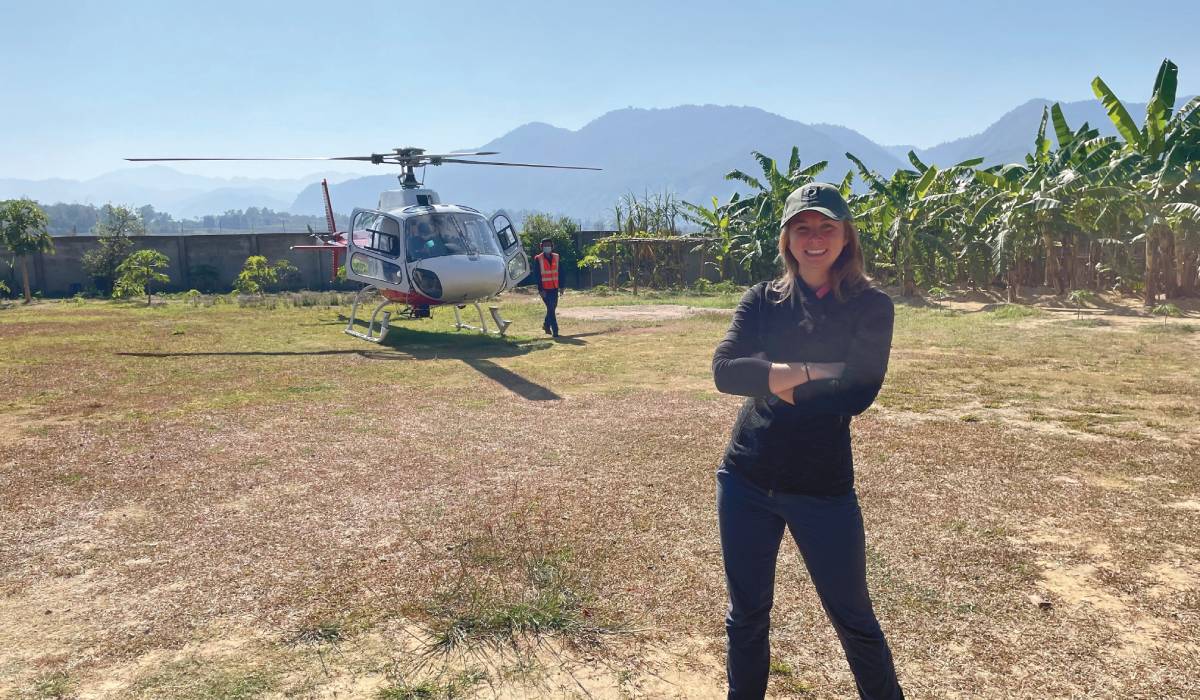
Perhaps the most unexpected and rewarding pathway I have embarked upon since graduating from Gettysburg is the one I am traveling down today. Since 2021, I have had the honor and privilege to work as a forensic anthropologist for the Defense POW/MIA Accounting Agency (DPAA), supporting the agency’s objective of recovering and identifying the remains of missing U.S. service members. As a laboratory analyst, I work directly with human remains and material evidence obtained from disinterments, field recoveries, or unilateral transfers. As a civilian scientific subject matter expert in the field, I guide teams in the archaeological survey and excavation of locations believed to be associated with missing U.S. service members. In this capacity, I have worked in Hawaii, Laos, Vietnam, Palau, and the Solomon Islands.
I am a firm believer in and advocate of the liberal arts model of education. It has served me exceptionally well in embracing the unknown and pursuing the unexpected. Gettysburg College taught me that challenges, while intimidating, are just fascinating, novel puzzles that require a mix of ingenuity, tenacity, and critical thinking to parse out. Whether I am hiking, running road races, or taking a helicopter deep into the jungles of Vietnam to hopefully bring closure to a family who has been waiting over half a century for answers, all pathways lead back to the mentorship, education, opportunities, and enduring relationships I had at Gettysburg.
Disclaimer: All views expressed here are personal.
by Katherine M. (Haas) Pompeani ’10
Posted: 03/25/26