Whether you're analyzing ancient ruins or exploring modern-day communities, Gettysburg’s anthropology program equips you with the knowledge, research opportunities, and real-world experiences to thrive. Here, you'll benefit from close faculty mentorship, immersive fieldwork, and unique global opportunities. You might conduct an archaeological excavation in Brazil, volunteer at a local museum, or develop your honors thesis while studying abroad. Eligible students can join Lambda Alpha, the National Honor Society for Anthropology, and build lasting professional connections through our alumni network.
Our graduates have gone on to attend graduate programs in top anthropology programs; join service programs such as City Year, Teach For America, and the Peace Corps; and enter fields as varied as law, medicine, education, government, finance, and the nonprofit sector.
The possibilities are endless!
As an Anthropology graduate, you might focus on a particular world area, such as Latin America, Asia-Pacific, Africa, Europe, North America, or the Middle East. Attend archaeological field schools or volunteer with projects. Past students have worked in the United States, Italy, Honduras, England, Macedonia, South Africa, and more.
With a liberal arts education at Gettysburg and a major in anthropology, students are prepared for virtually any career path. Employers embrace the cross-cultural experiences and sensitivity that anthropology majors possess. They also consider students’ solid grounding in anthropological research methods to be a plus. Our students have found work in the government and in the non-profit sector. In addition, many anthropology majors spend several years volunteering with Teach for America or the Peace Corps. Others attend graduate school to pursue further academic study in such fields as American Studies, Classics, History and, of course, Anthropology.

Anthropology in Action
- Olivia Taylor ’25 shapes her career through conversations on campus
- Distinguished Teaching Award bestowed upon Julia Hendon, Professor of Anthropology
- Noa Leibson ’20 unlocks dream career through faculty mentorship
- Gettysburg students excavate ancient Maya sites in Belize
- Honoring the Indigenous Past and Present
Hopkins House Archaeological Project
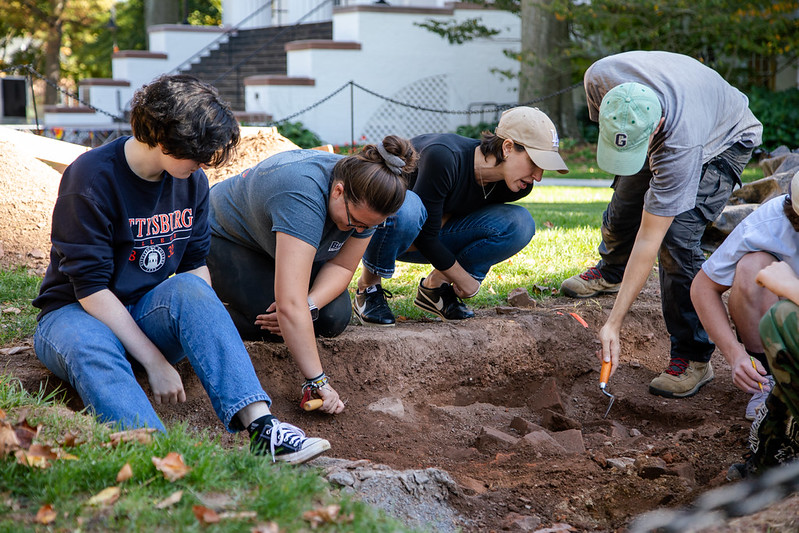
The Hopkins House Archaeological Project is a multi-year archaeological project that is being conducted on campus. The Hopkins House was located near the northwest corner of Penn Hall and was the residence of Jack Hopkins an African American man and the college’s janitor between 1848-1868.
This research is directed by professors Kirby Farah and Ben Luley and conducted by students in their classes—ANTH 324: Archaeological Field Methods and ANTH 212: Archaeology of Pennsylvania.
“I’ve always had varying interests and loved learning people’s stories.”
– Amy Evrard, Associate Professor of Anthropology
Lambda Alpha
The National Anthropology Honors Society Theta of Pennsylvania - Gettysburg College
Lambda Alpha is the national honor society for Anthropology. Its purpose is to encourage and stimulate scholarship and research in Anthropology by recognizing and honoring superior achievement in the discipline among students engaged in the study of Anthropology.
Eligibility
- student must be an anthropology major or minor
- he or she must have completed at least four courses in anthropology (none S/U)
- he or she must be a junior or senior
- he or she must have a minimum GPA of 3.6 in anthropology classes
- the student must have a minimum GPA of 3.5 overall
Every spring (usually in late March/early April) the department hosts an induction ceremony and dinner. The department also presents members with honor cords to wear at graduation. Lambda Alpha members are automatically eligible to complete an honors thesis in their senior year and encouraged to do so. For more information on an honors thesis, please see your advisor or consult the instructional documents filed on the Angel site.
To find out more, contact Donna Perry, faculty sponsor: dperry@gettysburg.edu
Featured courses
Jump to level: All Anthropology courses