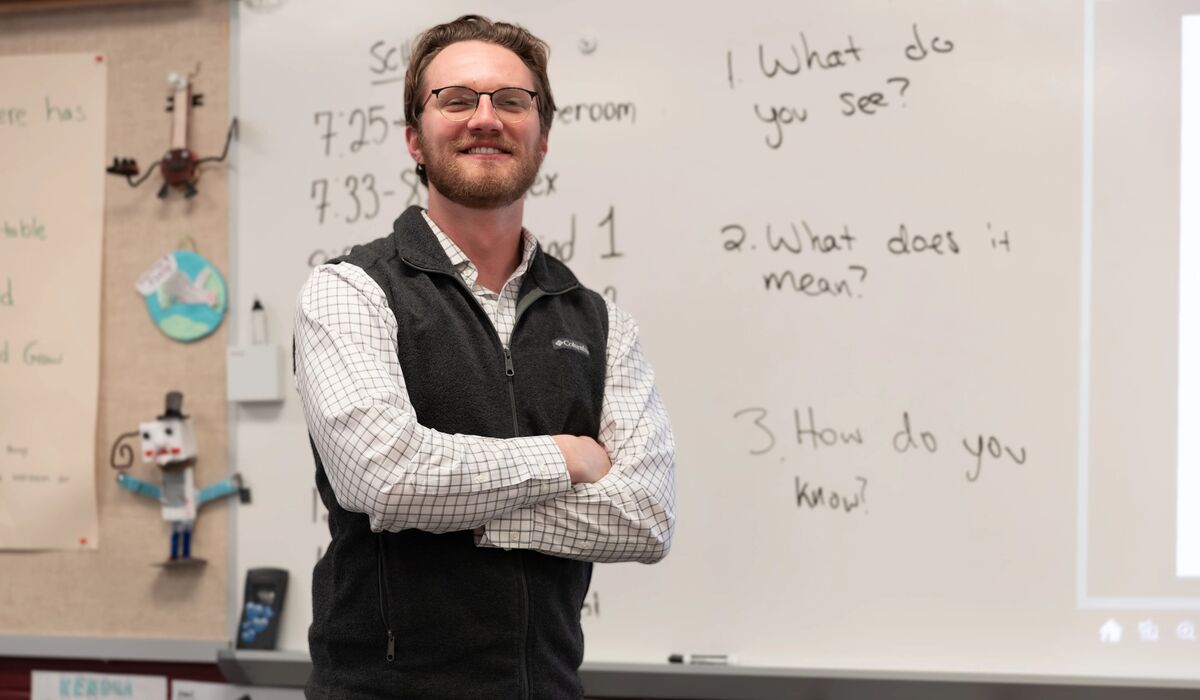
Through Gettysburg College’s Master of Education (M.Ed.) program, educators like Drew Martinelli learn to respond to the evolving demands of today’s schools. Gettysburg’s close-knit cohort model engages graduate students in collaboration and creativity as they develop research-informed solutions in educational design and inquiry.
Cocoa Valley, the D1 Chocolate Factory, and Moo Moo Milk Chocolate. No, this isn’t just a lesson in candy making. For the students in Drew Martinelli’s M’27 social studies classes at Gettysburg Area Middle School, it’s a unique opportunity to apply their historical knowledge of early 19th-century American industry to contemporary business growth and competition through a tangible, hands-on learning activity.
Martinelli’s desire to create an immersive classroom environment is one of many reasons he chose to pursue Gettysburg College’s Master of Education (M.Ed.) in Educational Design and Inquiry. For Martinelli, encouraging his students to build efficient, productive candy factories with hot glue guns and cardboard is one way to increase student engagement with the curriculum.
Created in 2025, Gettysburg’s new online M.Ed. program is the region’s first master’s program that sits at the crossroads of educational access and design thinking. The curriculum, which blends theory with practical application, prepares educators to think beyond routines and respond to the ever-evolving demands of today’s schools.
“I also like having the freedom to design my culminating projects. It’s an opportunity to choose something that I will use in the classroom with my students.”
– Drew Martinelli M’27
A native of Mechanicsburg, Pennsylvania, Martinelli has taught at Gettysburg Area Middle School for the past three years. He learned about Gettysburg College’s M.Ed. program through two colleagues at his school.
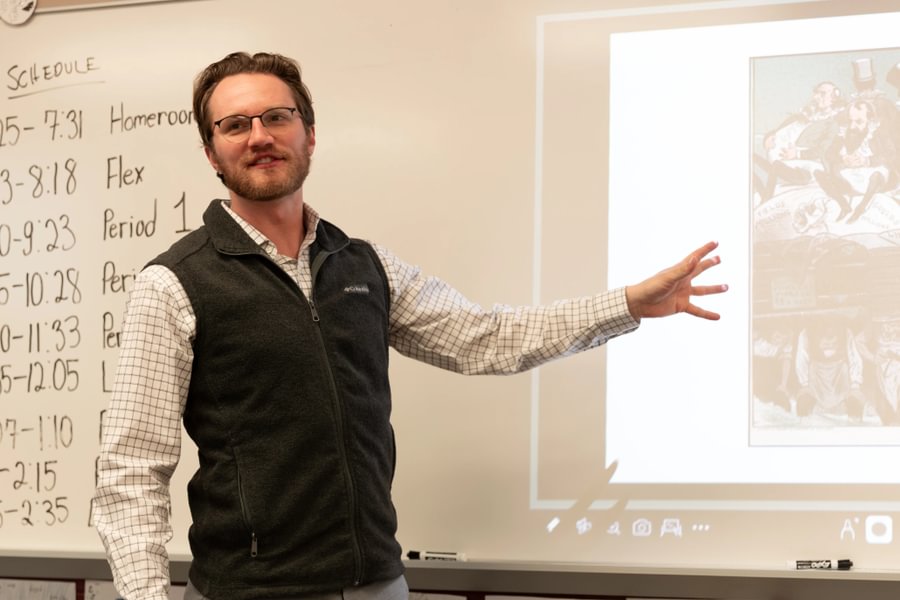
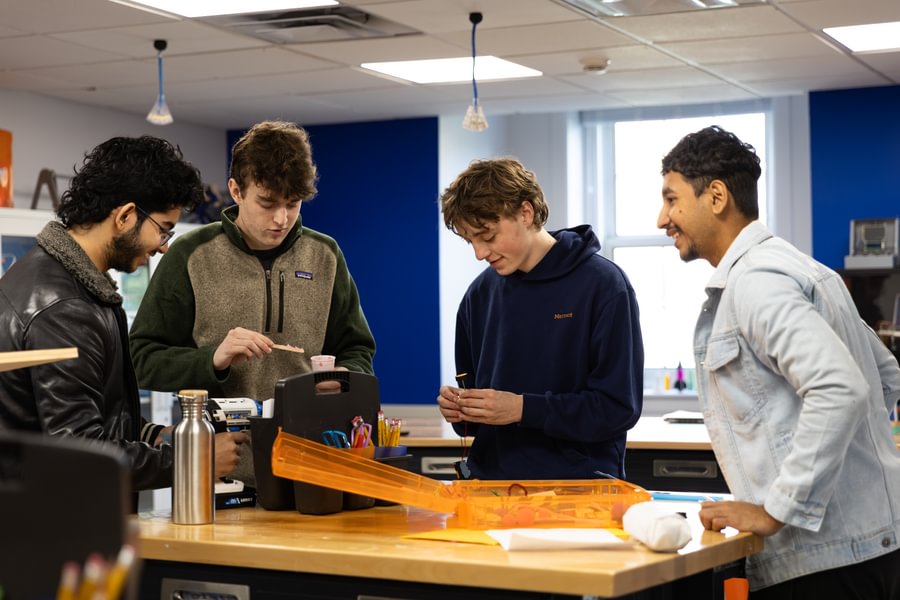
Martinelli explained that the close-knit, cohort model of Gettysburg’s master’s program stood out to him, and it’s why he ultimately chose Gettysburg College for his graduate education. He particularly enjoyed the design theory class taught by Josh Wagner, which used the resources of Gettysburg’s on-campus makerspace, The Rogers Center for Innovation and Creativity.
“I like the synchronous, once-a-week meetings and the on-campus makerspace to keep me engaged,” he said. “I also like having the freedom to design my culminating projects. It’s an opportunity to choose something that I will use in the classroom with my students.”
Martinelli said he’s applied the design-thinking experiences from Wagner’s design theory class to hands-on activities within his own social studies classes. When teaching about the robber barons who dominated early 19th-century American industry, for example, he divided students into groups and gave each a design challenge prompt.
“It might be, ‘How might our candy company eliminate competing companies?’ They then design something that answers that question. I have students completing blueprints and figuring out how to make their factories efficient,” he explained.
In a course taught by Prof. Divonna Stebick, director of the Office of Teacher Education and Certification, Martinelli focused his final project on empathy. Building on his experience in Stebick’s course, Martinelli had his students use primary sources and consider diverse historical voices through the lens of empathy during a Reconstruction unit he taught.
The collaboration and reflection that Martinelli fosters in his own classroom are hallmarks of Gettysburg’s M.Ed. program. Educators learn with and from one another within a professional community that emphasizes meaningful connection and mentorship.
“Students like Drew are what define the M.Ed. program,” Stebick said. “We attract educators who are not only reflective practitioners, but who see themselves as change agents—willing to question, disrupt, and redesign education through inquiry and design thinking. Their presence elevates the learning experience for everyone and reflects the kind of impact we aim to have in the field.”
Apply to Gettysburg’s Master of Education in Educational Design and Inquiry program.
Related Links:
By Michael Vyskocil
Photos by Tyler Caruso
Posted: 04/08/26