facebook    
 

Search


  Popular Topics


Student, prof use laser to research 'space weather'

        RSS          Comments         News@Gettysburg


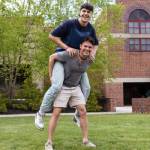
Senior physics major Matt Galante (left) and Prof. Tim Good in the laser lab

Physics Prof. Tim Good and senior Matt Galante's feet are firmly on the ground, but their minds are 100 miles straight up.

This past summer they used argon plasma (electrically charged gas) to simulate conditions at the edge of space, where particles flowing out from the sun interact with the upper atmosphere. This "solar wind" creates the beauty of the Northern Lights, but gusts known as "magnetic storms" can wreak havoc on satellites, cell phones, and power grids.

Good and Galante, a senior physics major from Telford, Pa., used a laser to measure changing conditions in the plasma and learn more about how to predict "space weather," which can also put orbiting astronauts at risk, forcing them to take shelter in lead-lined spaces that protect them from increased radiation.

"I knew that I would be doing a project of sorts with a professor, but I never imagined a project like this one," said Galante. "This is definitely one of the major highlights of my Gettysburg career. I have a great deal of interest in lasers, and would like to pursue them further in graduate school. My knowledge of them from my undergraduate research gives me a leg up over other graduate school candidates."

Gettysburg College strongly supports student-faculty collaboration. "We've got the tools and the know-how to emulate the work of much larger institutions," Good said.

"This is an experience we'd like more and more of our students to have," said Provost Janet Riggs, a psychology professor and 1977 graduate of Gettysburg College. "It provides deeper engagement with the subject matter and enhanced intellectual impact. It's a great investment in our students and one of the best things we as a faculty can do."

Numerous student-faculty research projects were under way this past summer, including:
    
    • How do we "keep an eye" on something? Junior psychology major and neuroscience minor James Taylor of Wilkes-Barre, Pa., and Prof. Kevin Wilson used a functional magnetic resonance imaging scanner to monitor brain activity as volunteers shifted their visual attention rapidly between objects or between areas on a computer screen. The National Science Foundation funded their work, which took place at the University of Pennsylvania in Philadelphia, through the Support of Mentors and Their Students in the Neurosciences program.
    
    • A real-life literary mystery of the high seas was at the heart of senior English major Patrick Holleman's work with English Prof. Temma Berg. The pair examined documents including letters written by 19th-century author Charlotte Lennox and her circle of acquaintances. Their goal was to determine whether Lennox, as a child, was aboard a ship bound from America to England when it was attacked by Spanish privateers. Berg and Holleman, of Portsmouth, R.I., also examined letters written by Bronte family members and their acquaintances as well as journal entries of Charles Clerke, who sailed around the world in the eighteenth century.

Issued 9/25/07

By Jim Hale


Comments


Gettysburg College 300 North Washington Street · Gettysburg, PA 17325
P: 717.337.6300